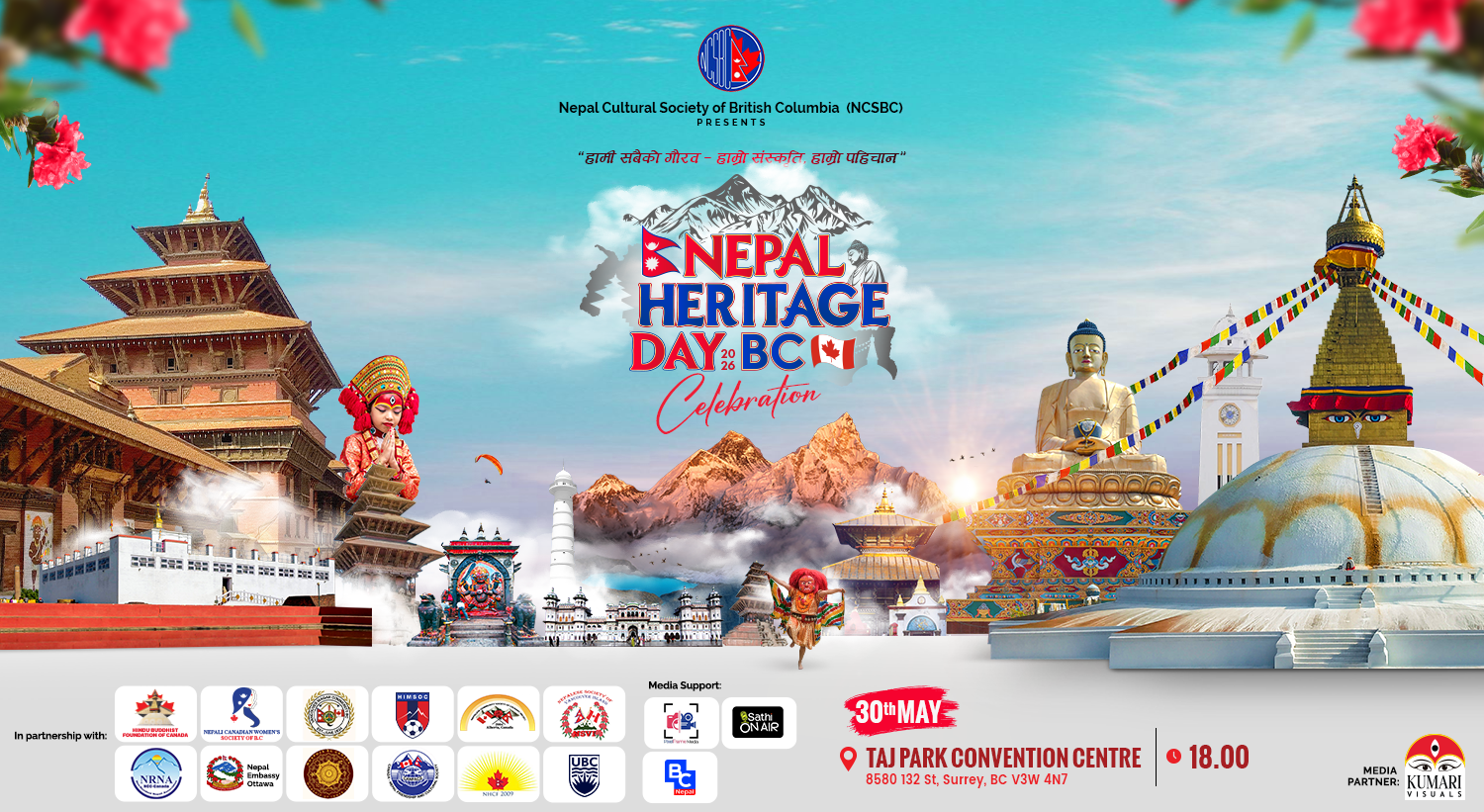
Nepal Heritage Day BC Celebration 2026
admin
Nepal, officially the Federal Democratic Republic of Nepal, is a landlocked sovereign state located in South Asia. It borders the Himalayas, including Mount Everest, the highest peak in the world. Nepal covers an area of 147,181 sq. km and extends over 885 km along the southern slope of the Himalayan range.
Nepal is a multi-ethnic, multicultural, multi-religious, and multilingual nation. It is regarded as the birthplace of Lord Buddha and Buddhism, which later spread throughout Asia. Nepal is one of the most culturally diverse countries in the world, with traditions, languages, and customs shaped by its unique geography and history.
According to the National Population and Housing Census 2021, Nepal is home to 142 distinct caste and ethnic groups who speak more than 125 languages. These languages belong primarily to the Indo-Aryan and Tibeto-Burman language families. Nepali, written in the Devanagari script, is the official national language.
Hinduism is the majority religion in Nepal and has profoundly influenced its social structure and traditions. Buddhism is also widely practiced, particularly among several ethnic communities. Other religions practiced in Nepal include Islam, Christianity, Jainism, Sikhism, and Kirant.
Nepal's national animal is the cow, its national bird is the Himalayan Monal, and its national flower is the rhododendron. The country's biodiversity is remarkable, with thousands of species of plants, mammals, birds, butterflies, and reptiles. Its diverse geography, ranging from tropical plains to the world's highest mountains, has created one of the richest natural environments on Earth.
The current population of Nepal is approximately 30 million. The country is known for its rich cultural legacy, diverse ethnic communities, and centuries-old traditions. The living heritage of the Kathmandu Valley reflects thousands of years of continuous cultural evolution and adaptation. The valley alone contains more than 1,100 government-registered monuments and hosts over 2,000 festivals.
Nepal's cultural heritage spans more than 2,500 years and is rooted in a unique fusion of Hindu and Buddhist traditions. The country's history began with early Kirat civilization, followed by the Licchavi Dynasty (approximately 400–750 CE), which brought significant advancements in art, architecture, trade, and governance. During the Malla Period (12th–18th century), Kathmandu, Patan, and Bhaktapur flourished as centers of culture and craftsmanship, producing many of the temples, palaces, courtyards, and monuments that define Nepal's heritage today.
Nepal is home to several UNESCO World Heritage Sites, including the historic cities of Kathmandu, Patan, and Bhaktapur, as well as the sacred sites of Boudhanath Stupa, Swayambhunath Stupa, Pashupatinath Temple, and Changu Narayan Temple. Sagarmatha National Park, home to Mount Everest, and Chitwan National Park are internationally recognized for their natural and ecological significance.
Nepal's artistic traditions are equally renowned. Patan, often called the "City of Artisans," is famous for its metal craftsmanship and religious sculptures. Bhaktapur is celebrated for its woodcarving traditions. Traditional art forms such as Thangka painting and Mithila (Maithili) art continue to thrive and represent important aspects of Nepal's cultural identity.
Nepali architecture reflects influences from South Asia, Tibet, and China. Distinctive styles include the Shikhara temple style and the Newar Pagoda tradition, which have inspired architectural developments throughout Asia. Historic figures such as Araniko helped introduce Nepali artistic and architectural excellence to China during the Yuan Dynasty. Conservation efforts led by renowned architect Carl Pruscha also played a significant role in preserving the cultural heritage of the Kathmandu Valley.
While Nepal's cultural heritage stretches back thousands of years, the story of the Nepali community in British Columbia is a more recent but equally inspiring chapter.
In 1994, there were approximately fifteen Nepali families in all of British Columbia. There was no formal organization, no cultural centre—just families finding one another, gathering in North Vancouver basements, sharing food, language, and traditions while building a sense of community far from home.
In 1996, when a fellow Nepali faced a medical crisis, a handful of community members came together near the Vancouver Aquarium to provide support. With no formal structure or funding, they simply helped one another. That act of solidarity became the foundation for future community-building efforts.
On December 27, 1998, twenty-six community members met in a Surrey basement and decided to establish a formal organization. Three months later, in March 1999, the Nepal Cultural Society of British Columbia was officially incorporated.
Today, thousands of Nepali Canadians contribute to communities across British Columbia—from Metro Vancouver to Prince George and the Okanagan. They serve as doctors, teachers, engineers, entrepreneurs, artists, students, and community leaders, enriching the province's social, cultural, and economic landscape.
In recognition of these contributions, British Columbia officially proclaimed Nepal Heritage Day. For the first time in the province's history, Premier David Eby formally recognized the Nepali community as a distinct, valued, and enduring part of British Columbia's story.
Nepal Heritage Day is more than a celebration of culture. It is a recognition of a community's journey, resilience, and contributions—a tribute to generations who preserved their heritage while helping build a stronger and more diverse British Columbia.
Explore Related Posts
Dive deeper into our insights, tips, and creative techniques.
Never Miss Our Latest Articles
Subscribe to our newsletter for exclusive photography tips, tutorials, and behind-the-scenes content delivered straight to your inbox.